

Feb. 4, 2026
Falls Among Hospitalized Patients Reduced by Half in a Clinical Study Using Circadian Lighting Equipped with Nichia's Dynasolis™
Tokushima, Japan – 4 February 2026: Nichia, the world's largest LED/Laser Diode manufacturer and inventor of the high-brightness blue and white LEDs, is pleased to announce that research findings on a circadian lighting1 environment incorporating Nichia's Dynasolis™ technology have been published in Healthcare, an international open-access medical journal from Switzerland (MDPI). This study was conducted by Dr. Takeshi Okinami, Vice Director of Akashi Ninjyu Hospital in Japan. The results showed that the number of hospitalized patients who experienced falls in rooms equipped with circadian lighting (using Dynasolis™) was reduced by approximately half compared to patients staying in rooms illuminated with conventional fluorescent lighting.
Study Overview
Paper
Title: Circadian Lighting Was Associated with a Reduction in the Number of Hospitalized Patients Experiencing Falls: A Retrospective Observational Study
URL: https://doi.org/10.3390/healthcare13141692
Details
Facilities implemented a lighting environment that takes circadian rhythms2 into account in the hospital ward. By adjusting the color temperature and the light–dark cycle, it aims to improve patients' sleep patterns and wakefulness, and to verify whether this can help prevent falls.
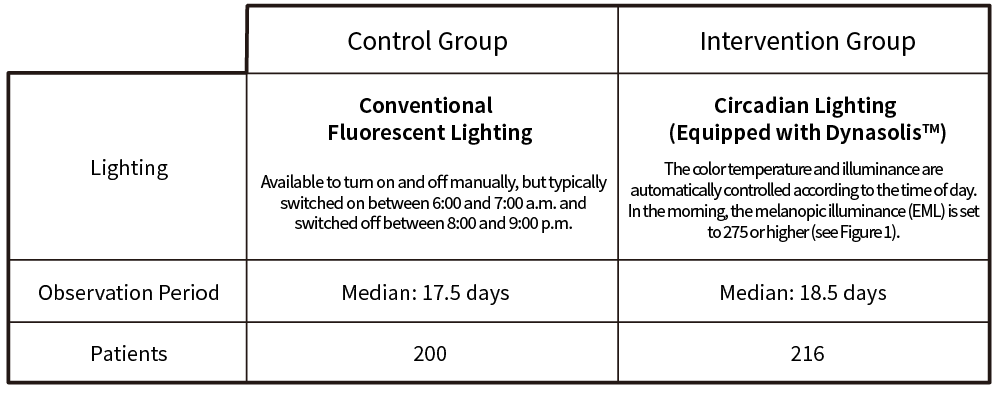
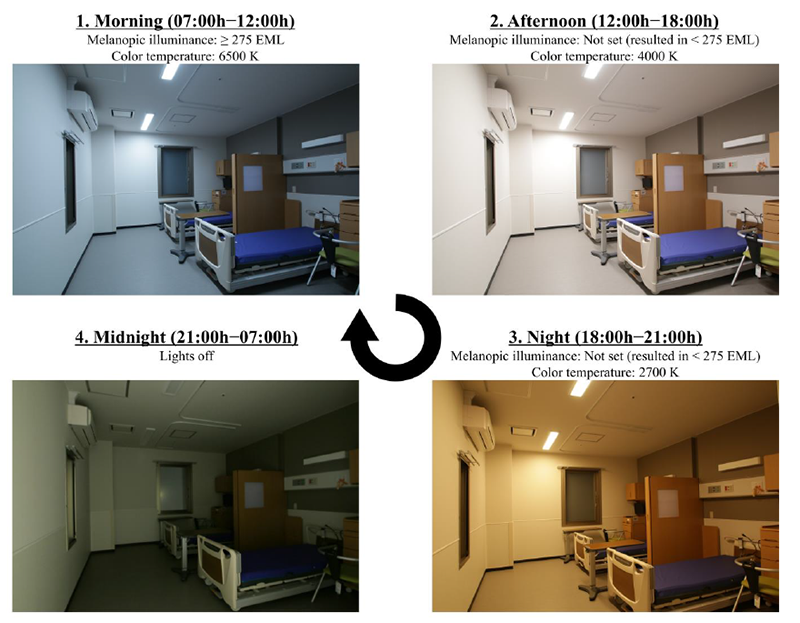
Figure 1. Hospital Room Equipped with Circadian Lighting
(Source: Healthcare, 2025, 13(14), 1692)
Results
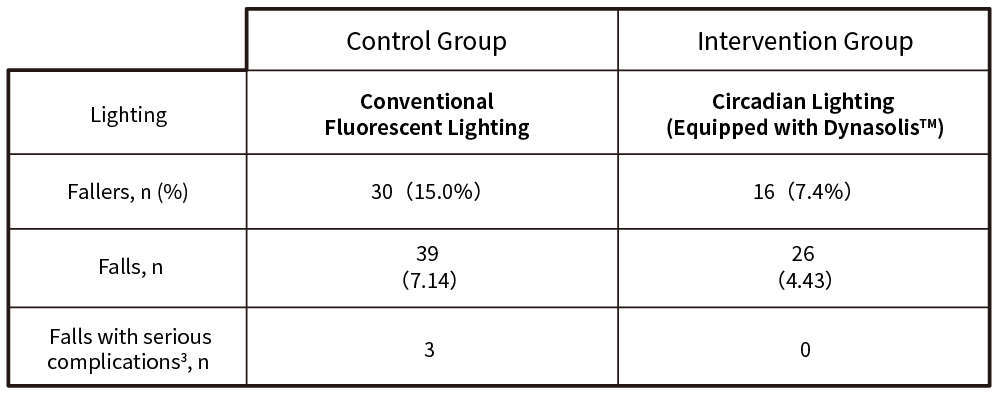
The percentage of people who experienced falls was reduced from 15.0% to 7.4%, nearly halving the rate.
Furthermore, even after accounting for risk factors such as older age (≥80 years), the use of anticonvulsants, medications for dementia and sleep, the introduction of circadian lighting was associated with an approximately 44% reduction in fall risk.
Comment by Dr. Takeshi Okinami

“Living organisms possess an internal clock that enables them to adapt to the Earth's 24-hour environmental cycle. The suprachiasmatic nucleus (the central clock) in the brain synchronizes the peripheral clocks4 of various organs and cells, controlling the overall rhythm of the body, with light stimuli being the primary synchronizing factor. However, changes in the light environment in modern society disrupt the body's internal clock, becoming a cause of a wide range of health problems, including sleep disorders, cardiovascular diseases, and cognitive decline.
To address these issues, circadian lighting provides a physiologically appropriate light environment. In our clinical study, the introduction of circadian lighting into hospital rooms significantly reduced fall risk among inpatients by 44%. These results suggest that normalization of circadian rhythms through light intervention contributed to fall prevention by improving sleep disorders, delirium, and nocturnal frequent urination.
A major advantage of circadian lighting is that it is non-invasive5 and associated with extremely low risk of side effects, making it highly suitable for clinical use. Considering its potential to reduce the burden on healthcare and caregiving staff—as well as the associated economic impact—circadian lighting–based fall prevention could become a new standard. With further adoption of circadian lighting, we expect that evidence for its preventive effects will continue to grow, potentially expanding its role as a new option for preventing and treating various disorders associated with circadian misalignment.”
Dynasolis™ is an LED solution designed to physiologically promote the optimization of circadian rhythms by combining energizing azure (sky blue) LEDs with calming warm white LEDs. Exposure to azure light stimulates the secretion of serotonin, which helps regulate the body's internal clock and activates the mind and body from awakening through the morning, ultimately leading to melatonin production in the evening. Through this study, circadian lighting has demonstrated its potential as a new approach to fall prevention.
Nichia is committed to developing products that use light through LED technology, aiming to enable people to lead healthy and fulfilling lives. By promoting the widespread adoption of circadian lighting not only in hospitals but also in nursing facilities and residential homes, Nichia strives to enhance safety and comfort, contributing to the creation of pleasant and supportive environments.
For more information about products, refer to Nichia's website: Dynasolis™
For inquiries regarding product, use the Contact Form.
Note:
1 Circadian lighting: Lighting that automatically adjusts its color and brightness throughout the day to mimic the natural changes of sunlight.
2 Circadian rhythm: A biological rhythm with a cycle of approximately 24 hours that living organisms possess.
3 The three falls noted in the control group were as follows: One ischial fracture, one rib fracture, and one subdural hematoma and rib fracture.
4 Peripheral clocks: Internal clocks located in organs such as the liver and heart, which work together with the central clock in the brain to regulate rhythms related to metabolism, hormone secretion, and other bodily functions.
5 Non‑invasive: A method that can be performed without damaging or physically harming the body.