

Apr. 22, 2026
Nichia's HPS Color LEDs (1800K) Show Reduced Insect Attraction in Joint Research
Tokushima, Japan – 22 April 2026: Nichia, the world's largest LED/Laser Diode manufacturer and inventor of the high-brightness blue and white LEDs, and Tokushima Agriculture, Forestry and Fisheries Technology Support Center have conducted a joint research study to evaluate the low insect attraction characteristics of Nichia's HPS color LEDs (1800K). In this study, two types of evaluations, laboratory tests and outdoor tests, were carried out to clarify the effects of LEDs with different correlated color temperatures (CCTs) on insect attraction. As a result, it was confirmed that the 1800K LED showed the lowest level of insect attraction among the evaluated light sources.
Test Summaries
1. Laboratory Test
LEDs with multiple CCTs were used to comparatively evaluate the degree to which insects are attracted to different light sources.
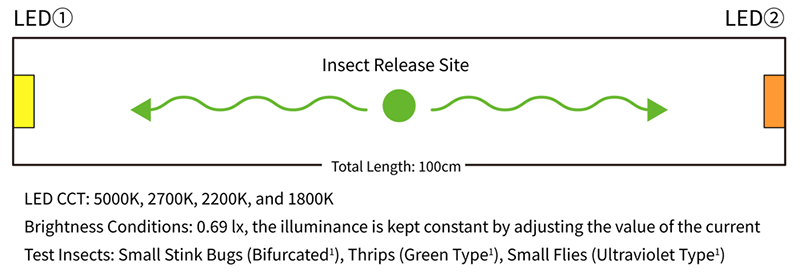
In the test, LED ① and LED ② were installed at opposite ends of a linear test space with a total length of 100 cm, and test insects were released from a central release point. By observing and recording which LED direction the insects moved toward and were attracted to, the relative insect attraction of LEDs with different CCTs was evaluated and compared.
Test Outline Diagram:
Test Results:
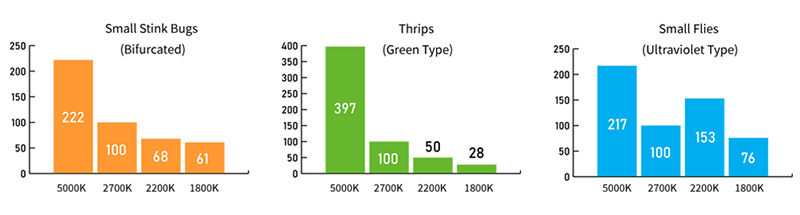
Among the evaluated CCTs, it was confirmed that the 1800K LED showed the lowest level of insect attraction.
The relative attraction number2 (with 2700K set to 100) is shown in the graph below.
2. Outdoor Test
An outdoor evaluation was conducted under actual field conditions to assess insect attraction to LEDs with different CCTs.
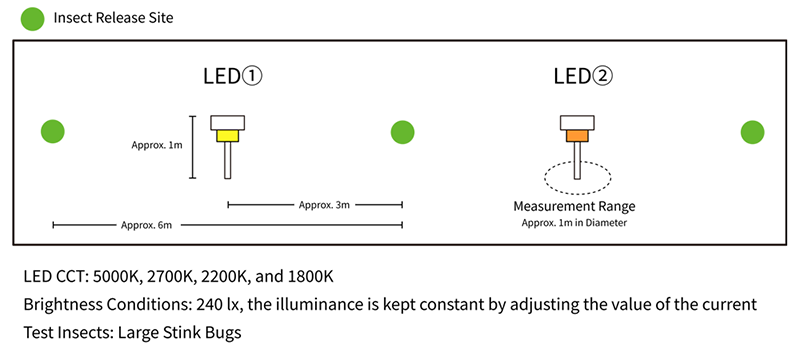
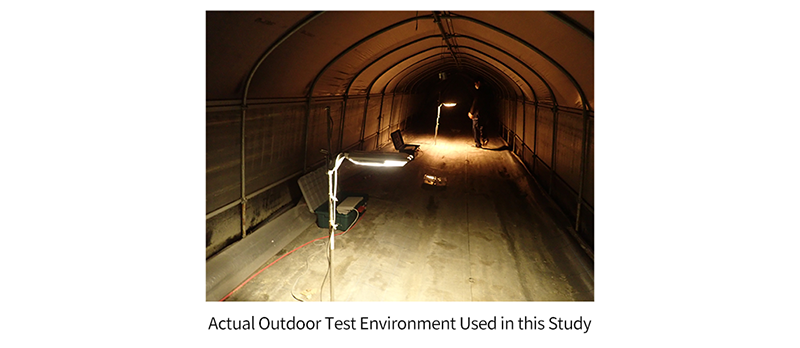
In the test, LED ① and LED ② were installed at a height of approximately one meter above the ground. Test insects were released from three release points: one located outside LED ①, one positioned midway between the two LEDs, and one located outside LED ②. After release, the insects attracted to each LED were observed and recorded within predefined measurement areas (approximately one meter in diameter) surrounding each light source. The results were then comparatively evaluated to assess differences in insect attraction between the LEDs.
Test Outline Diagram:
Test Results:
The outdoor test results also confirmed that the 1800K LED showed the lowest level of insect attraction.
The relative attraction number2 (with 2700K set to 100) is shown in the graph below.
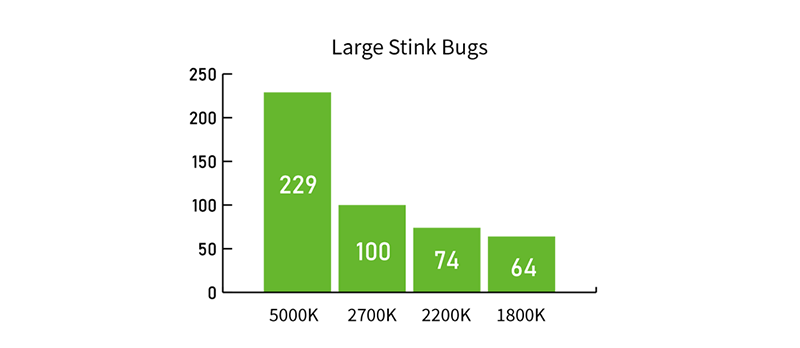
Consistent trends were observed in both the laboratory and outdoor tests, clearly demonstrating that HPS color LEDs (1800K) have lower insect attraction compared with LEDs of other CCTs.
In March 2026, Nichia expanded its low CCT portfolio of the high-power LED, NVSW219GL3, including 1800K. By adopting a ceramic substrate, NVSW219GL achieves high reliability and is characterized by high output and long lifetime. It is ideal for outdoor lighting applications—such as street and roadway lighting—where fixtures must withstand rain, wind, and wide temperature variations. Based on the results of this study, this new addition in Nichia's HPS color LEDs is expected to contribute to improved comfort in outdoor spaces where people gather, such as sidewalks, parks, and areas around building entrances, by helping to reduce insect attraction. In addition, these LEDs are expected to serve as an effective lighting solution that reduces environmental impact in areas adjacent to natural environments and in locations where consideration for ecosystems is required.
Nichia will continue to develop lighting technologies that ensure safety and comfort for people while reducing environmental impact, thereby contributing to the realization of a sustainable society.
For more information about products, refer to Nichia's website: HPS color LEDs
For inquiries regarding product, use the Contact Form.
Notes:
1 The classifications “Bifurcated,” “Green Type,” and “Ultraviolet Type” are based on insects' spectral sensitivity, which describes their response characteristics to light.
2 Relative values of the number of insects measured in each test.
3 NVSW219GL is Nichia's part number.